
We did not automate sales. We automated the admin around it
ed.png)
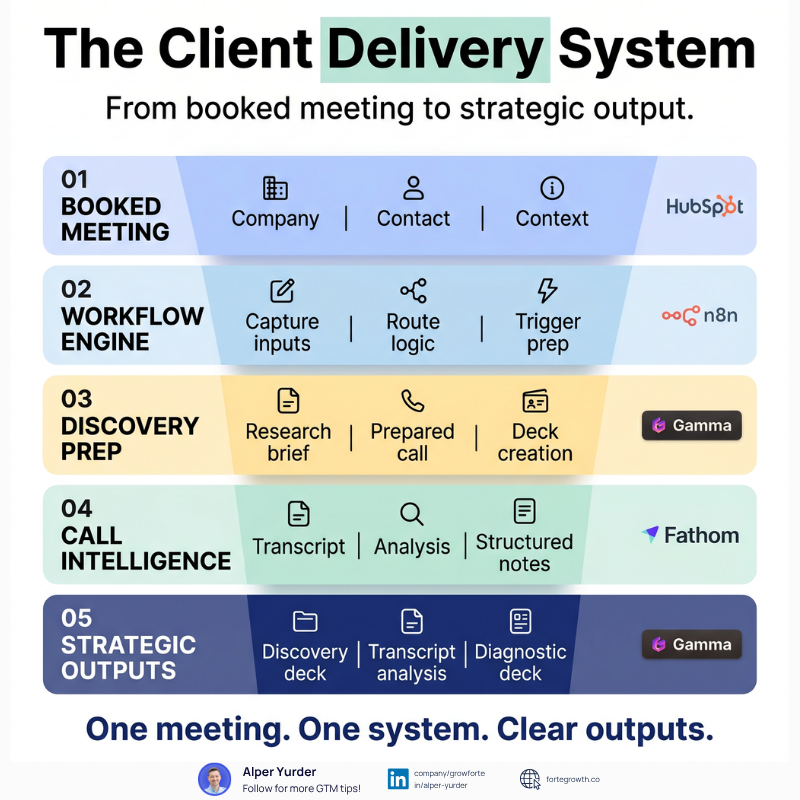
So we could spend more time solving client problems, not managing the process around them.
A lot of teams say they want to automate sales. I think that is the wrong framing. You should not automate the parts that require judgment. You should automate the parts that drain it.
The real problem is usually not the client conversation. It is everything around it. Booking flows. Prep. Research. Internal handoffs. Note-taking. Summary writing. Action tracking. Deck building. Routing. Follow-up admin.
That is where good teams lose hours. And that is exactly the layer we’ve been building around our sales and advisory process.
The idea was simple: Remove as much operational drag as possible from the journey between booked meeting and final proposal.
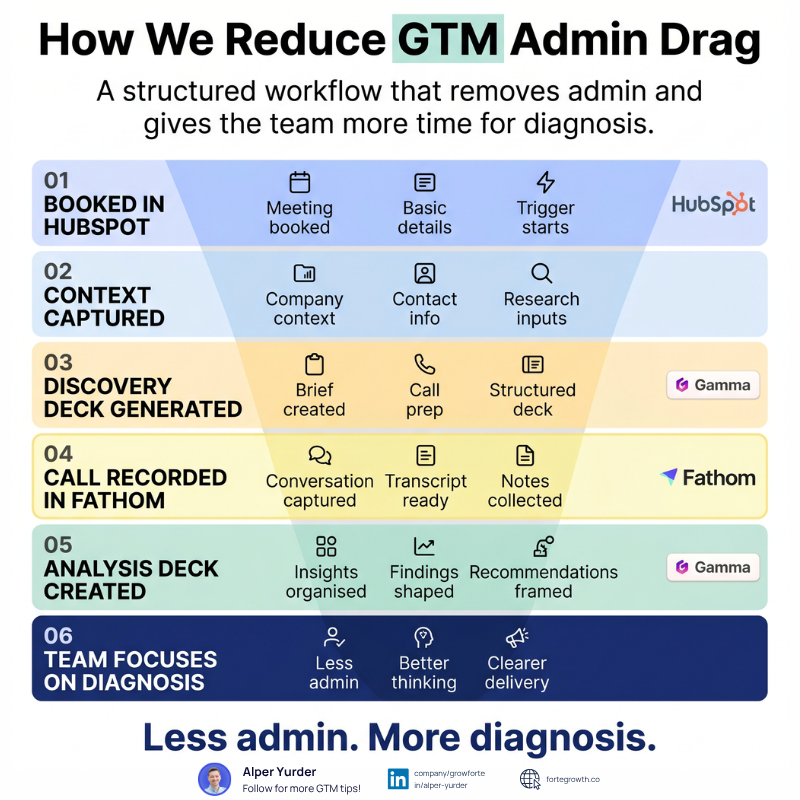
When a prospect books a meeting through HubSpot, they submit the information we need up front. From there, our n8n workflow pulls that context, structures it, and triggers the next steps automatically.
We use that input to generate a discovery deck in Gamma, then send it into the relevant Slack channel so we can prepare properly before the call. That means the team is not starting cold. We already have context, structure, and a working point of view before the conversation begins.
Then we run the discovery call.
After that, Fathom captures the meeting and transcript. Once the call is done, the workflow picks that up and uses it to generate a diagnostic-style analysis deck in Gamma. That becomes the working document we refine internally before the final client conversation.
So instead of spending our time copying notes, rewriting summaries, building decks from scratch, and chasing admin across tools, we spend more time on the part that actually matters: understanding the client’s problem, sharpening the diagnosis, and shaping the right next step.
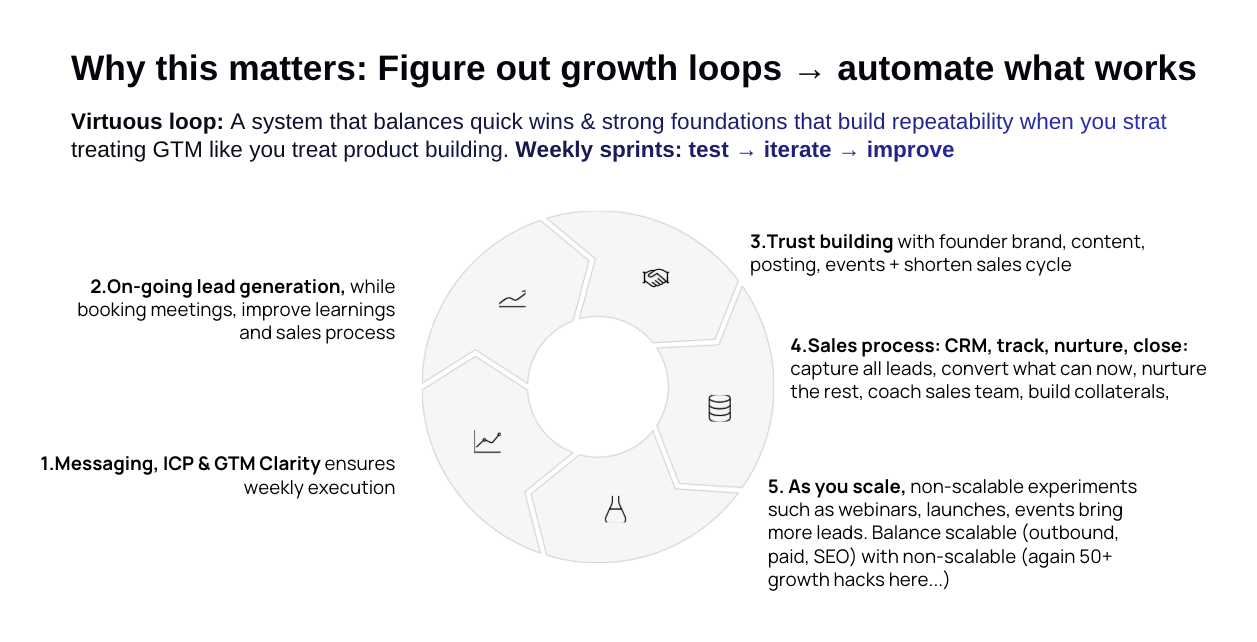
What we actually automated: Not the thinking. The process around the thinking.
That distinction matters. We are not trying to remove human judgment from sales. We are trying to remove repetitive operational work that gets in the way of good judgment.
Here is the flow in practice:
A lead books through HubSpot and shares the right context up front.
n8n pulls the information and pushes it into the workflow.
Gamma generates a draft deck for the discovery conversation.
That deck is dropped into Slack so the team can review and prepare.
We hold the meeting with the client.
Fathom records the call and captures the transcript.
The transcript feeds back into the workflow.
Gamma then produces a second analysis or diagnostic deck based on what was actually said in the meeting.
We review, refine, and use that as the basis for the final conversation.
That is the system. It is not flashy for the sake of it. It is useful. It reduces friction. It shortens the distance between conversation and action. And it means our time goes into interpretation, diagnosis, and decision-making instead of process handling.
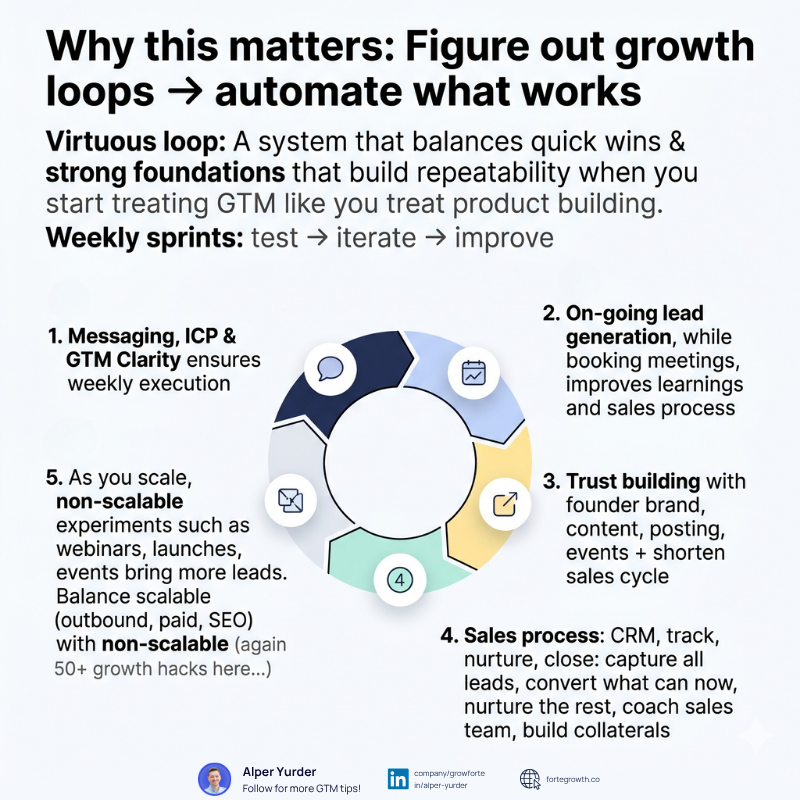
Why this matters: You shouldn’t be obsessed about “automation for the sake of it”
Rather focus on what will save you time, create virtuous loops to:
test → iterate → improve
While removing manual and friction causing activities through an integrator like N8N, Zapier or Make.
This allows you to actually focus on:
sharper thinking, faster diagnosis, clearer next steps, and confidence that the people in the room know what they are doing.
The operational layer either supports that or slows it down.
If the team is manually collecting inputs, manually rewriting notes, manually turning calls into decks, and manually passing context between tools, a surprising amount of energy gets burned on work that does not actually move the client forward.
That is why we built this system the way we did. Not because automation is trendy. Because it creates more room for real work.
The stack itself is fairly simple: What matters is how the tools work together.
HubSpot handles meeting capture and front-end client information. The n8n acts as the orchestration layer. Gamma helps turn structured inputs into usable decks. Slack becomes the operating environment for internal visibility and preparation. Fathom captures the conversation and transcript after the meeting.
Then the workflow loops that insight back into the process so the team is not starting from a blank page after every call. None of those tools are magic on their own.
The leverage comes from designing the process properly so that information moves cleanly from one stage to the next.
If you want to build this yourself: Here is roughly how
Start with the design, not the tools.
Map your journey from booked meeting to final proposal. Mark every spot where someone copies information, rewrites notes, chases context, or rebuilds a deck from scratch. Those are your automation candidates. Pick the two or three that hurt the most.
Build the pre-call loop first.
This is the highest-leverage half. The flow looks like this:
Replace your booking link with a HubSpot meeting form that asks for the right context up front. Company, role, problem area, current stack. Three or four fields max.
Set up an n8n workflow triggered on form submission. n8n pulls the form data, enriches it if needed, and pushes a structured payload forward.
Pipe that payload into Gamma to generate a discovery deck. Use a fixed prompt and a fixed template so the output is consistent.
Drop the finished deck into a Slack channel the team actually watches, with a short summary of who is meeting whom and when.
Once that loop is running cleanly, you have already removed most of the prep drag. Run it for two weeks before you touch the next part.
Then build the post-call loop.
Connect Fathom (or Grain, Fireflies, whatever you use) so transcripts land somewhere n8n can read.
Trigger a second n8n workflow once a transcript is available.
Feed the transcript into a Claude or GPT step with a prompt that pulls out the diagnosis, the priorities, and the open questions.
Push that structured output into a second Gamma deck. That becomes your working analysis document.
Drop it back into Slack for internal review before the follow-up call.
A few things worth getting right.
Use one source of truth for client data. HubSpot for us. Do not let n8n become the database.
Keep your prompts in version control or at least a Notion page. You will tweak them constantly, and you want to see what changed when output quality drifts.
Build for the team you have, not the team you wish you had. If your AE will not open Slack, do not put the deck in Slack.
Do not try to automate the whole journey on day one. Get one loop working. Run it. Improve it. Then add the next.
If you would rather not figure it out from scratch.
This is exactly the kind of system we build with clients inside the first 30 days of a Forte engagement. Same logic, faster path, fewer dead ends. If you want to see the actual n8n workflow and the prompts we use, reply to this email or message me on LinkedIn.
Happy to walk you through ours and help you map yours.
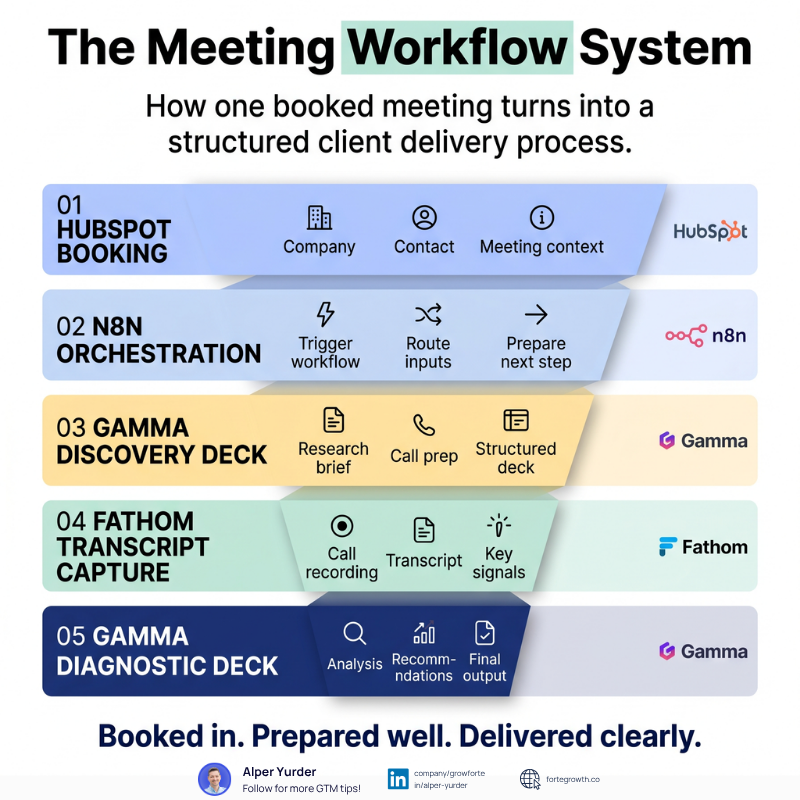
The real advantage: We spend less time managing the process and more time improving the outcome.
That is the whole point. The more operational drag you remove, the more attention you can give to the client’s actual problem.
Better discovery.
Better diagnosis.
Better recommendations.
Better final conversations.
A lot of firms still burn strong people on weak process. We would rather build the process properly and use our energy where it creates the most value.
The real system
Done well, this is not just automation. It is workflow design in service of better client work.
The meeting gets booked.
The context gets captured.
The deck gets built.
The team prepares.
The meeting gets analysed.
The diagnostic gets sharpened.
The final conversation becomes stronger.
That is what we mean when we talk about building GTM systems. Not more busywork. More leverage.
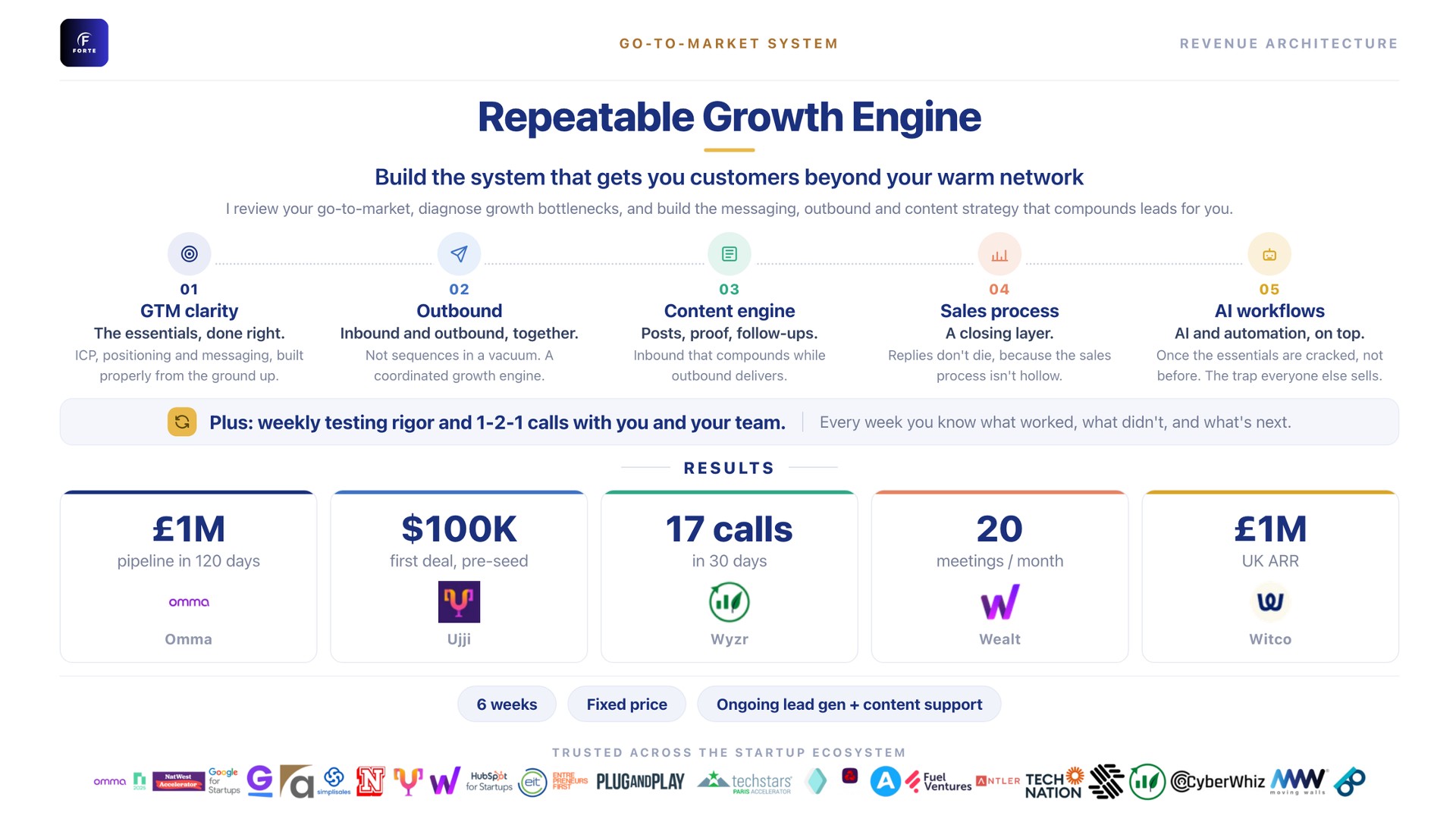
New from Forte: The Repeatable Growth Engine
Over the last year, we worked with 100+ founders and revenue teams across 20+ engagements.
The pattern was clear: most early growth comes from warm intros, founder hustle and one-off campaigns. Then the referrals slow down, outbound gets patchy, content sits on the side, and the founder is still stuck in every sales conversation.
So we built the Repeatable Growth Engine.
It is a 4 to 6 week GTM system designed to help founders move beyond scattered tactics and build a pipeline that compounds.
We diagnose where growth is breaking, fix the essentials around ICP, positioning, messaging and sales process, then get inbound, outbound, content and follow-up working together.
The goal is simple: a system your team can run, not another advisor sitting on the side.
You can see the full launch post here.
If this is useful
If you are trying to create a cleaner sales or advisory process without drowning your team in admin, this is exactly the kind of system we help build.
At Forte Growth, we help B2B founders and revenue teams build go-to-market systems that generate leads, create clarity, and turn good conversations into real commercial momentum.
Ready to move forward
Talk to us about your GTM challenge and we'll recommend the right fit.