How do we define our ICP when different roles have bought from us?
The company is the ICP and the roles are personas inside it. Forte Growth locks one company profile with its trigger to buy now, maps the people in each deal, and sets ninety days as the point where closed revenue should confirm the choice.
Does the role that signed decide our ICP?
No, the company does. Forte Growth's 90-Day GTM Clarity and Execution Tracker keeps the ICP and the persona on separate rows: the ICP is the company, its industry, size, stage, geography and its trigger to buy now. SMBs is a description; a Series A fintech in the UK with 20 to 50 people that has just hired its first sales team is an ICP.
How do we find the real ICP inside the customers we already have?
Read them by how they bought. Forte Growth's GTM Journal, March 2026 lines them up by who bought fastest, paid the most and complained least, and reads the real ICP off that group, not off the deck.
Forte Growth's 13 Symptoms of a Broken Pipeline explains bad-fit leads that scored well: the scoring ran on the company with no filter on the person. It sends the fix to ICP and persona precision, the pillar that looks from outside like broad demographic targeting with no anti-ICP.
Who inside the company is actually the buyer?
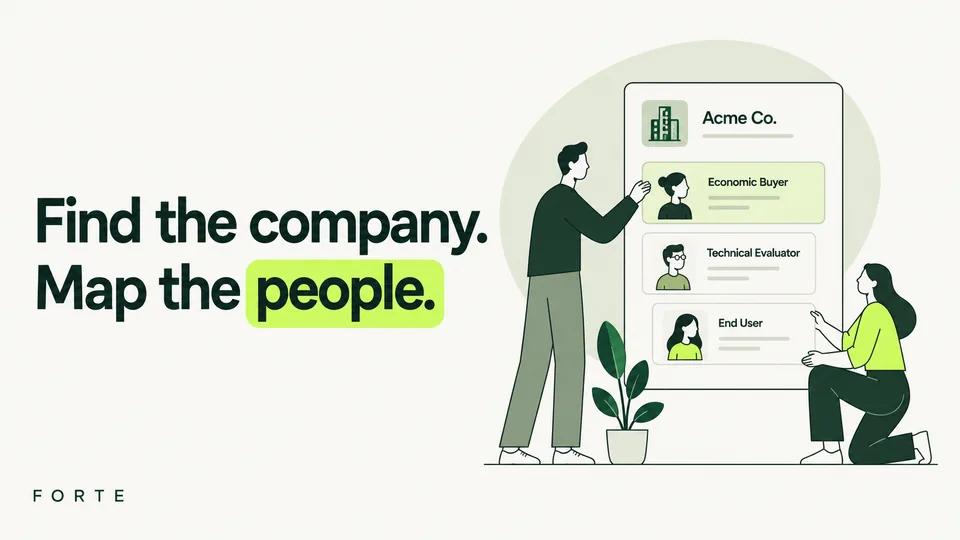
Usually three roles. Forte Growth's From Zero to GTM Engine (Founder-led Sales & AI) playbook starts the sales motion from three people in a deal: the end user who works with the product every day, the decision maker who approves the purchase and the economic buyer who controls the budget. Check who held each role in your own closed deals; one person can hold more than one of them. The role decides the message; the company decides who is on the list.
Should we sell to every role that has bought, or pick one?
Start with one, unless each group is already defined. Forte Growth's 13 Symptoms of a Broken Pipeline, built from around fifty GTM diagnostic conversations, names three go to markets in parallel as a repeating pattern, a founder running at several half-defined personas at once, and its fix is to pick one for ninety days. More than one can run when each has its own pains, triggers and campaign: for Wyzr, Forte Growth narrowed the market to two practical buying groups, each with its own pains and triggers, and ran segmented campaigns against both.
What does Forte Growth build and run?
Forte Growth builds and runs your go to market and marketing from the buyer definition outwards: the ICP and anti-ICP, persona cards, tiered lists built on behaviour and signals, a message and proof per persona, and the CRM stages behind them. It improves it on what each campaign teaches until it gets you results.
Your definitions stay with your company, the sales conversations stay with your team, and closed revenue, checked at ninety days, tests the choice. Writing to the buyer you have named is the next question: "Our product is hard to explain. How do we write one message for several buyers?"
ALPER YURDER · FORTE GROWTH
Alper Yurder on SaaS Insiders on users telling their own story of what a product is, and the founder's job of choosing which of them to double down on, with the full transcript.
What should we do first?
Take the diagnostic. Ten focused questions show where the commercial constraint sits and the best next move, with an instant result and no email gate.
Related playbook: The 90-Day GTM Clarity and Execution Tracker, the ICP row worked through: the company profile a good answer names, and the milestone it has to hit by day ninety.
Related case study: Wyzr, a market narrowed to two practical buying groups, then segmented campaigns run against both.